YOU KNOW HOW THE FANCY ASS WACOM CINTIQS ARE HELLA EXPENSIVE LIKE $1,000 USD TO $2,000 USD?
WELL CHECK OUT THIS BABY:
THIS IS THE YIYNOVA MSP19U AND ITS LITERALLY JUST $600 USD AND IS PRETTY MUCH THE SAME EXACT THING AS A CINTIQ BUT YOU DON’T HAVE TO SELL YOUR LIFE AWAY TO WACOM FOR IT.
BRAH. IT COSTS AS MUCH AS MY WACOM INTUOS 5 LARGE TABLET COST BUT MINE YOU CAN’T LOOK AT YOUR HAND WHEN YOU DRAW BECAUSE ITS JUST OPAQUE PLASTIC.
DO YOU KNOW HOW MUCH I WISH I KNEW ABOUT THIS BEFORE I GOT MY INTUOS? A LOT. SO IF YOU’RE WANTING A FANCY ASS DRAWING TABLET GET THIS LIL GUY.
I thank Domics on YouTube for pointing this out because WOW. FUCK.
In the 19th century, Spanish blacksmiths, mainly those of Albacete and Seville, had a custom of engraving “leyendas” or inscriptions on their blades.
Si esta vibora te pica, no vayas a la botica | If this viper (knife) stings you, don’t go to the pharmacy.
Si esta bivora te pica no vayas por ungüento a la botica viva las al clini dueño ~ año 1894 | If this viper (knife) stings you, no need to ask for an ointment from the
pharmacy, go straight to see the director of the hospital – (in the year)1894
Si esta vibora te pica no ay remedio en la botica, soy defensa de mi dueño. | If this viper (knife) stings you, you won’t find any remedy at the
pharmacy
– I defend my master.
Si esta vibora te pica, no vayas por ungüento a la botica no me sueltes de las manos que hay muchos enamorados. | If this viper (knife) stings you, don’t go to the
pharmacy
to get an ointment – Don’t let me down because I have a lot of admirers
Al que esta vibora le pica no encuentras remedio en la botica. | If this viper (knife) stings you, don’t go to the
pharmacy
to get a remedy
Si esta vibora te pica no ay remedio en la botica, soy defensa de mi dueño. | If this viper (knife) stings you, don’t go to the
pharmacy
to get a remedy – I defend my master.
Valor ! | Courage !
Viva España | Long live Spain
Soy defensor de mi amo. | I am the defender of my master
Soy de mi dueño. | I belong to my master
Biba el onor de mi Dueño | Long live my master’s honour
Viva mi dueño. | Long live my master
Soy española – Soy de mi Dueño solo | I am Spanish – I belong solely to my master
Ole! Que viva mi dueño que no es un guaja. Es un mozo valiente con la navaja | Olé! Long live my master who is not a coward. He’s a brave man with a knife
Soy sola de mi dueño | I have only one master
Sirbo a mi dueño. | I serve my master
Biba mi dueño y señor | Long live my Lord and master
Soy defensora de mi dueño | I defend my master
Soy de mi dueño defensora. | I am, for my master, the defender
Soy defensora de mi dueño hasta el morir | I defend my master until death
Soy defensora de el honor de mi dueño y señor solo | I defend the honour of my sole Lord and master
Defensador de mi dueño atras que soy Catala del 1886 | I am the defender of my master who is behind me – Catala (in the year) 1886
Soy defensa de mi dueño porque le cuesta el dinero soy de acero fino y fuerte y el que me quiera probar lo bera | I defend my master – I cost him money because I am made of fine strong steel and whoever wants to verify this will be able to
Biba el balor de mi dueño y señor | Long live the courage of my Lord and master
Soy para cortar y no para ser presta | I am made to cut and not to be lent
Soy defensa de valiente de color des hinocentes solo de mi dueño soy y por otro no me voy. | I defend courage in the name of the innocent and belong to no one except my master
Tengo hechos y no palabras | I act and do not talk
Esta no se presta oy mañana si | This knife is not to be lent today, but tomorrow.
No me dejes de las manos que ay muchos enamorados | Don’t let me down because I have lots of lovers
No me dejes de las manos pues ay muchos enamorados | Don’t let me out of your hands because there are many who admire me
No me sueltes de las manos que hay muchos enamorados | Don’t let me fall from your hands because I have many admirers
No me abras sin razon ni me cierres sin honor solo de mi dueño soy y con otros no me voy. | Don’t open me without a reason and don’t close me without honour – I belong solely to my master and do not go with others
No me abras sin razon ni me cierres sin onor | Don’t open me without a reason and don’t close me without honour
No me saques sin razon ni me guardes sin honor | Don’t withdraw me without a reason and don’t close me without honour
Soi andaluza de Sevilla, no me abras sin razon ni me sierres sin onor | I am an Andalusian from Sevilla – Don’t open me without a reason and don’t close me without honour
Si abro la cerrada vengan moros para mi | If I open this blade, the Moors will be with me
Mi corazon se abra por mi amada | My heart opens for my loved one
No me presto ni me doy solo de mi dueño soy | Don’t lend me or give me away, I only belong to my master
Vino – Toros – Mujeres | Wine – Bulls – Women
No te fies de un borracho. | Don’t trust a drunk
Pincho corto. | Short tip
Para todos sirvo. | I serve everyone
Con mi acero y| tu valor nunca temas la ocasion | With my steel and your bravery never fear what might happen to us
De la tierra y de la mina esta materia nació a complacerte se inclina el alma te ofrecio. | This matter was born from the earth and the mine to please you and offered you its soul
Soy mas valiente que el Cid y valgo mas que el mundoentero. Soy mas valiente matando que Manuel Garcia el espartero. | I am more valiant than the Cid and am worth more than the entire world. I am more a valiant killer than Manuel Garcia the Espatero (famous Toreador who died at 28 on June 27 1894)
Si quieres saber mi valor hoy afindas mi honor – año de 1867 | If you want to know my courage, offend my honour now – in the year 1867
Yo àcompaño a los baliente Si no me quiere sacàr doi palabra si je’ ofrece de salir à bentilar | I accompany the worthy. If you don’t want to take me out, I stay quiet, if you decide to take me out, I speak
Soy Andaluza de Sevilla | I am an Andalusian from Sevilla
Ole Soy Andaluza de Sevilla año 1881 siglo 19 ole viva my dueño, olé viva la españa y la andalusia ole viva la jilanta(?) Andaluza que Sevilla año 1881+ signature" | Olé! I am an Andalusian from Seville, year 1881 in the 19th century. Olé! Long live Spain and Andalusia. Olé! Long live the Jilanta ( ?) Andalusian from Seville – in the year 1881
Atras o morir a Dios | Retreat or offer your soul to God
Cuando acaricia mi mano la cacha de esta navaja hasta los valientes tremblan al ver mis bravas harañas | When my hand caresses the handle of this knife, even the bravest tremble before my brave exploits
Donde Acero Ha de Hablar, La Lengua Ha de Callar | When steel must speak, the tongue must stay quiet
No tiembla mi mano porque el acero es toledano | My hand does not tremble because the steel comes from Toledo
Ravenclaw: Rain pounding on the windows. Book pages being turned. The world underwater. A heart beating. The flutter as cards are shuffled. Piano music. The whisper of the wind.
Gryffindor: Fire crackling. A cat purring.
The pop as a cork is removed from a bottle.
Thunder. High heels tapping against tile floors.
Birdsong. The roaring crescendo of applause.
Slytherin: Waves crashing against the sand. Fresh snow crunching underfoot. Whale song. Coins clinking against each other. Ice cubes in a glass. Old music. The silence right after a storm.
Hufflepuff: Laughter. Leaves rustling in the breeze. The soft murmur of a stream. Bumblebees buzzing. Stones skipping across a lake. Bubbles popping. The final note before a song fades away.
Useful if this is how you think, though often I don’t see the outline until after the draft is written, because after awhile one just internalize this kind of stuff from all the media one ingests. Point is, use if helpful, ignore if not.
Another suggestion for anyone interested: because one of my weaknesses as a writer is sustaining narrative momentum, I’ve recently started using this mystery novel breakdown as a template, even though mystery/detective isn’t the genre I write in. It’s really useful as a way to keep track of what the story needs at a given moment in terms of balance and character.
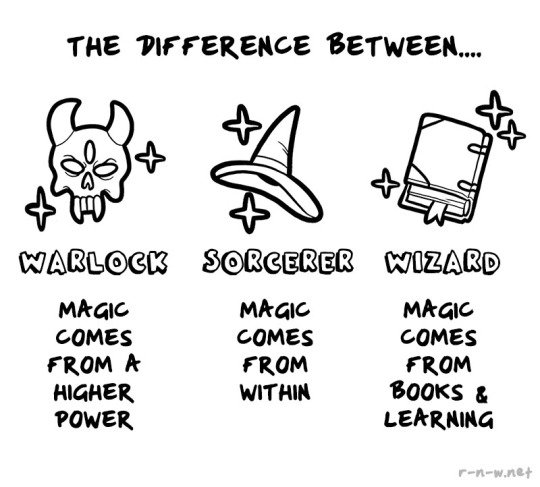
As an entry-level DnD player can someone explain to me in the simplest possible way how to differentiate wizards, warlocks, and sorcerers from each other?
wizards is imbued with magic, you just need to prepare mentally your spells.
sorcerer studied magic, you need to physically prepare your spells and often need materials.
warlock has magic because of demon, you have access to mainly dark magic as well as eldritch blast as a free unlimited cantrip.
to be honest, play-wise wizards & sorcerers are very similar as they tend to have a lot of shared spells. sorcerers get to specialize in a school of magic more than wizards though. and warlock its pretty much just dark magic.
this, except reverse wizards and sorcerers.
sorcerers innately have their magic (usually because someone fucked a magic being. often a dragon)
wizards studied magic and learned accordingly. they also tend to be older, but not always.
warlocks get their magic from pacts with magic beings (which i don’t think necessarily have to be demons).
A REAL LIST OF ACTUAL NAMES AND THEIR (approximate) PRONUNCIATIONS: Siobhan — “sheh-VAWN” Aoife – “EE-fa” Aislin – “ASH-linn”
Bláithín – “BLAW-heen”
Caoimhe – “KEE-va”
Eoghan – Owen (sometimes with a slight “y” at the beginning)
Gráinne – “GRAW-nya”
Iarfhlaith – “EER-lah” Méabh – “MAYV” Naomh or Niamh – “NEEV” Oisín – OSH-een or USH-een Órfhlaith – OR-la Odhrán – O-rawn Sinéad – shi-NAYD Tadhg – TIEG (like you’re saying “tie” or “Thai” with a G and the end)
I work with an Aoife and I have been pronouncing it SO WRONG
As someone who is trying and failing to learn Gaelic, I feel like is an accurate portrayal of my pain.
This is the Anglicized spelling of a people who really fucking hate the English.
No, no, this is the orthographic equivalent of installing Windows on Mac.
The Latin alphabet was barely adequate for Latin by the time it got to the British Isles, but it’s what people were writing with, so somebody tried to hack it to make it work for Irish. Except, major problem: Irish has two sets of consonants, “broad” and “slender” (labialized and palatalized) and there’s a non-trivial difference between the two of them. But there weren’t enough letters in the Latin alphabet to assign separate characters to the broad and slender version of similar sounds.
Instead, someone though, let’s just use the surrounding vowels to disambiguate–but there weren’t enough vowel characters to indicate all the vowel sounds they needed to write, so that required some doubling up, and then adding in some silent vowels just to serve as markers of broad vs. slender made eveything worse.
They also had to double up some consonants, because, for example, <v> wasn’t actually a letter at the time–just a variation on <u>–so for the /v/ sound they <bh>. AND THEN ALSO Irish has this weird-ass system where the initial consonant sound in a word changes as a grammatical marker, called “mutation,” so they had to account somehow for mutated sounds vs. non-mutated sounds, which sometimes meant leaving a lot of other silent letters in a word to remind you what word you were looking at.
And then a thousand years of sound change rubbed its dirty little hands all over a system that was kind of pasted together in the first place.
My point is, there is a METHOD to the orthography of Irish besides “fuck the English.” The “fuck the English” part is just a delightful side-effect.




 Help Me Improve My Art
